About Us
Organizational Overview
History
Mission
Organizational Overview
(in German)
Founded in 1982, Project Interchange is an educational organization dedicated to the first-hand introduction of Israel and its regional historical and contemporary challenges to current and future United States and international leaders. A cornerstone of Project Interchange seminars is the presentation of differing viewpoints on the complexities and nuances of controversial issues in Israel and the Middle East such as the Israeli-Palestinian and Israel-Hezbollah conflicts.
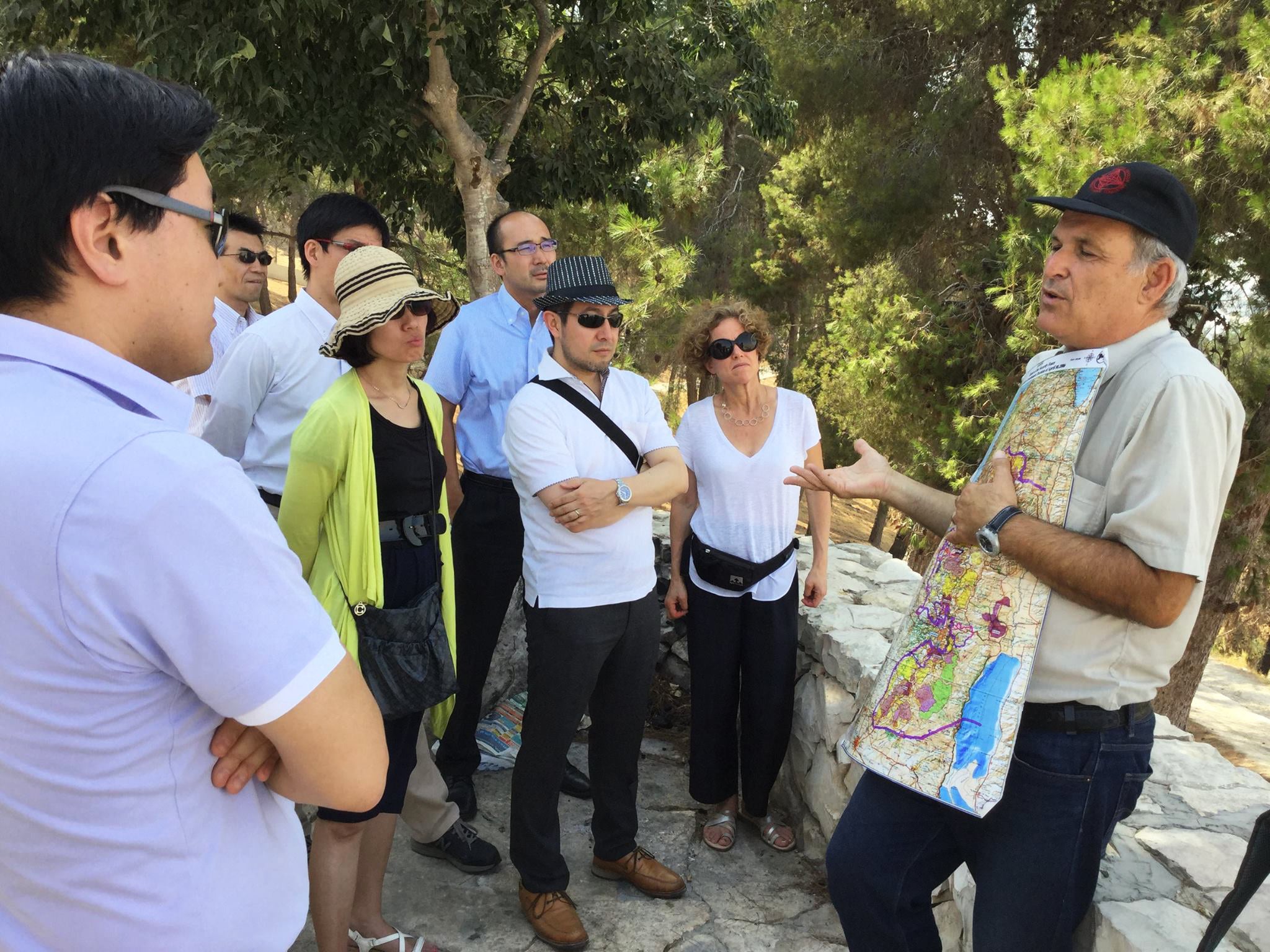
Project Interchange has brought over 4,500 prominent United States and international figures to Israel on our week-long seminars which include meetings, site visits, and touring. Each seminar is tailored to address the interests of its delegation (e.g., immigrant absorption, education, counter-terrorism, politics, and environment), while introducing participants to Israel’s complexity and diversity. All groups engage in meetings with government officials, analysts, and clergy. Participants are exposed to the successes and challenges of immigrant absorption through candid discussion with new and former immigrants. These leaders also learn about the challenges to Israeli-Arab society and the plethora of issues confronting Palestinians in the West Bank and Gaza. Visits to cutting edge co-existence and social and economic empowerment programs along with tours of historical and archeological significance complete the wider picture of Israel today. We also include orientation and alumni programming and relationship-building.
Project Interchange is an institute of the American Jewish Committee, the oldest human relations agency in the United States. The American Jewish Committee works to combat bigotry and to promote pluralism and tolerance in the U.S. and abroad. Celebrating its twenty-fifth year, Project Interchange is a non-profit, non-political 501(c)3 organization funded by individual donors, private foundations and Jewish federations.
History
A History of Project Interchange
told by its Founder Debbie Berger
The creation of Project Interchange was a long process. Although it is entering its twenty-fifth anniversary year in 2007, the motivation behind its inception had begun ten years earlier, in 1973.
It was that year, during the war between Israel and Lebanon, that Debbie Berger, the Founder of Project Interchange, became increasingly concerned as she realized how few people knew, or cared to know, about the situation in the Middle East. She could not understand how so many people could not care about Israel. This troublesome issue stayed with her as she pursued a Master’s degree in political science and anthropology, focusing on the Middle East. Her Master’s Thesis was on the subject of “Who’s Doing What in Middle East Studies.”
It was in the period of July 1980 ‑ June 1981, however, that the idea for Project Interchange crystallized. Debbie Berger and her entire family were on sabbatical in Israel. While there, Berger visited some twenty Middle East study centers in her quest to learn. She often discussed what she was learning with a longtime friend, Hanan Baron, a wonderful thinker, and then Director-General of the Foreign Ministry. They discussed how Berger would channel her newfound knowledge upon her return to the United States. Baron spoke of a small-scale delegation that was sent to Israel that had been organized by the Van Leer Institute. This idea of educational seminars for small groups of influential figures inspired Berger’s vision of Project Interchange.
She concluded that orchestrating first-hand encounters with Israel would be the best way to inform people about the country. She would organize seminar trips for leadership groups with potential for the future, which would have influence in their respective circles, to see the realities -- not the mythologies -- of Israel. She believed that the most fundamental component of this “project” was a commitment to facts, not indoctrination, about Israel. She thereby designed programs that conveyed the complicated and multi-tiered entity of Israel as a counter-weight to the oversimplified vision that was so prevalent.
Upon her return to the United States, Berger began working 60 hours a week on this unique organization. She lived, breathed, and ate Project Interchange, its challenges and frustrations. She started working from home, but shortly thereafter, friends provided her with an office, free of charge, from which to run Project Interchange.
At the beginning, reactions to the project were largely negative, putting pressure on Project Interchange and Debbie Berger to prove its value. Nonetheless, there were quite a few staunch supporters who believed in the success of this enterprise from the very start. As time progressed, the success of Project Interchange could be seen in the changing attitudes of the seminar participants as well as the willingness of donors to support Project Interchange.
Project Interchange began as a volunteer organization, as Debbie Berger, Judy Linowes, and Mimi Charnoff would put in full days for no compensation. They made contacts in Israel, working with the Jerusalem Institute to develop and plan the trips and speaking engagements. In 1984/5, Project Interchange hired Aviva Meyer, its first Executive Director, who continued to work with Berger and the other initial “volunteers.” The groups that were sent to Israel continued to grow, and remained unique in their focus on tailored seminar trips among peer groups.
In 1992, Berger decided that it would be important to institutionalize the organization, to ensure that it would keep running without being solely dependent on her steam power. She met with David Harris, then head of the Washington office of the American Jewish Committee, and decided to entrust the organization to him. After “shopping around” other organizations, Berger decided that the values of Project Interchange aligned most clearly with those of the American Jewish Committee. This umbrella organization also had a long history of supporting “institutes” that, though affiliated and deeply tied, remained largely independent. Paul Berger, Debbie’s husband, who had been the lawyer for Project Interchange, and Al Moses, another early supporter and then President of the American Jewish Committee, created an agreement that would join PI and AJC while providing for a separate institute that would maintain independence for programming and direction. This joint venture brought Project Interchange a larger platform that would reach a broader audience.
At this point, Project Interchange took on a life of its own, continued to expand, and continues to take current and future leaders to Israel as an institute of the American Jewish Committee.

Mission
as of 12/5/06
Project Interchange, an institute of the American Jewish Committee, provides current and emerging United States and international leaders with an enhanced understanding of, and perspective on, Israeland the pursuit of Middle East peace through introductory educational seminars in Israel.